What the 2026 NAAA Arbitration Changes Mean Before You Bid Remotely
Remote bidding gives dealers access to far more wholesale inventory, but it also places more weight on condition reports, announcements, photos, sale lights, and auction policies.
The National Auto Auction Association updated its Arbitration Guidelines effective June 1, 2026. Several changes affect how buyers should evaluate risk before placing an online bid, particularly on higher-value vehicles and vehicles equipped with advanced driver-assistance systems.
Not every item in the update represents a completely new rule. Some changes create new thresholds or disclosure requirements, while others formally document practices that auctions were already using.
NAAA is also not an enforcement body. Individual auctions may adopt the guidelines in whole or in part, and their own terms and local policies control the transaction. Dealers should review both the NAAA guidelines and the specific auction's rules before bidding.
Higher-Value Vehicles Have a Different Arbitration Threshold
For vehicles purchased for less than $50,000, an undisclosed mechanical defect must cost at least $800 to repair before it qualifies for arbitration.
For vehicles purchased for $50,000 or more, the threshold is now 2% of the purchase price.
That means:
- A $50,000 purchase has a $1,000 threshold
- A $75,000 purchase has a $1,500 threshold
- A $100,000 purchase has a $2,000 threshold
The threshold applies to each individual defect. Several smaller problems generally cannot be combined to reach it.
A repair that might support an arbitration claim on a $35,000 vehicle could fall entirely on the buyer at $55,000. Higher-value vehicles may therefore require a larger uncertainty allowance when the condition report cannot fully address their mechanical or electronic systems.
Generic "No Arb" Announcements Are Not Enough
The updated guidelines prohibit generic announcements such as "No Arb for Oil Leaks" when they do not identify the actual condition.
A seller should disclose the specific defect, announce a related component problem, or sell the vehicle under an appropriate as-is condition. An ambiguous announcement may itself become grounds for arbitration.
Before bidding remotely, ask:
- Does the announcement describe a specific defect?
- Is the vehicle being sold green, yellow, red, or blue light?
- Do the written listing and condition report agree with the live announcement?
- Does the auction impose additional restrictions on that announcement?
- Is enough information available to estimate the likely repair exposure?
If the disclosure is unclear, the right response may be a lower bid or no bid. Arbitration should be treated as a limited safeguard, not a substitute for understanding the vehicle.
A Warning Light or Diagnostic Code Does Not Explain the Defect
Announcing a check-engine light or diagnostic trouble code does not automatically relieve the seller of arbitration responsibility. The underlying defect still matters.
A generic DTC may indicate anything from a minor sensor issue to a costly engine, transmission, emissions, or electrical problem. A code without a diagnosis does not give the buyer enough information to price the risk accurately.
When a remote listing includes a warning light or DTC:
- Determine whether the underlying problem has been diagnosed.
- Check whether a more specific announcement was made.
- Estimate both the likely repair and a reasonable worst-case repair.
- Confirm how the sale light and local auction rules affect arbitration.
- Reduce the bid ceiling when the uncertainty cannot be resolved.
A code can help identify where to investigate. It should not be treated as a complete condition disclosure.
Mileage Representations Can Be Binding on Exempt Vehicles
Mileage-exempt status does not make every mileage statement meaningless.
The updated language clarifies that a mileage representation made verbally, electronically, in a listing, or in a condition report can still be binding. Sellers are also responsible for disclosing known or apparent mileage inconsistencies.
Remote buyers should preserve the listing and condition report used to make the decision. If the displayed mileage affects the bid, confirm that it is consistent across the runlist, photos, history report, condition report, and announcements.
The word "exempt" should prompt a closer review of what has actually been represented.
Buyers Get One Mechanical Arbitration Filing
The updated guidelines clarify that a buyer gets one opportunity to file a mechanical arbitration claim for a vehicle.
Multiple mechanical defects can be included in that filing, but each defect must independently meet the applicable dollar threshold. A mechanical filing does not prevent a separate structural-damage or vehicle-history claim within the appropriate deadline.
Once the vehicle arrives:
- Inspect it promptly
- Scan all systems
- Road-test it when permitted and safe
- Check the announced components
- Document every potential defect
- Review the auction deadline before submitting the claim
Do not file a mechanical claim before the vehicle has been inspected thoroughly enough to identify every qualifying issue. A piecemeal process can leave a later-discovered problem outside the single filing opportunity.
Transportation Time Can Consume the Claim Window
NAAA arbitration deadlines begin with the sale date, which counts as Day 1. A vehicle can spend a meaningful part of that window waiting for pickup or traveling to the dealership.
Before buying remotely, confirm:
- The auction's exact arbitration deadline
- How quickly the vehicle can be transported
- Whether a post-sale inspection is available
- Where the vehicle can be inspected after arrival
- How many miles may be added without affecting eligibility
The transporter should also document the vehicle's condition before leaving the auction. Damage that is not recorded at gate release may become the buyer's responsibility.
If transportation timing would leave too little time for a proper inspection, arrange a PSI or other inspection before the vehicle leaves the auction.
ADAS Risk Is Now Explicitly Addressed
The guidelines now formally address advanced driver-assistance systems, including adaptive cruise control, blind-spot monitoring, parking sensors, collision warning, lane-keeping features, and camera systems.
If an ADAS component is housed in a visibly damaged part, such as a bumper, mirror, or windshield, the related ADAS problem may not be arbitrable. The same applies when the damage was disclosed in the listing or condition report.
If the associated part was not damaged or disclosed, standard arbitration eligibility can still apply.
This creates a significant remote-buying concern. A photo may show bumper or windshield damage without revealing whether the radar unit, camera, sensor, wiring, mounting bracket, or calibration has also been affected.
When damage involves an ADAS-equipped component, the bid should account for:
- Diagnostic cost
- Sensor or camera replacement
- Mounting hardware
- Wiring damage
- Calibration
- Transportation to a qualified facility
- Additional time before retail readiness
NAAA notes that ADAS diagnosis may require a qualified third party outside the auction. Responsibility for the related costs can depend on the outcome of that diagnosis.
Title Rules Now Address Future Brands More Clearly
The title policy now more clearly recognizes cases where an undisclosed pre-sale defect is expected to create a future title brand and prevent the buyer from obtaining clear, marketable title.
A buyer must provide evidence that the underlying condition existed at the time of sale. Relevant documentation may include DMV records, insurance declarations, law-enforcement reports, or prior auction history.
A vehicle-history report can help identify a concern, but the report alone generally does not create an arbitration claim. The buyer must establish the underlying undisclosed damage, title problem, mileage discrepancy, or other qualifying condition.
This reinforces the importance of checking title status and vehicle history before bidding. It also means the dealer should preserve the supporting records used to make the decision.
A Better Remote-Bid Checklist
Before placing a remote bid, verify:
- Sale light and sale type
- Every written and verbal announcement
- Condition-report scope and inspection date
- Photos of high-risk areas
- Warning lights and diagnostic codes
- Mileage representations
- Structural, title, and history information
- ADAS equipment and related visible damage
- Auction-specific arbitration thresholds and deadlines
- Mileage allowed after the sale
- PSI availability and coverage
- Transportation time
- Estimated landed cost
- Repair contingency
- Local retail exit and target gross
Save the listing, announcements, condition report, photos, and sale receipt. Online information can change or become unavailable after the sale.
Arbitration Protection Should Affect the Bid, Not Replace It
The 2026 changes provide more clarity around disclosures, diagnostic codes, high-value vehicles, ADAS, mileage, mechanical claims, and title issues.
They do not make remote purchases risk-free.
The buyer still needs to understand the vehicle, the announcement, the sale light, the auction's local policy, and the cost of uncertainty. The farther the vehicle is from your lot, and the less direct inspection you can perform, the more important that discipline becomes.
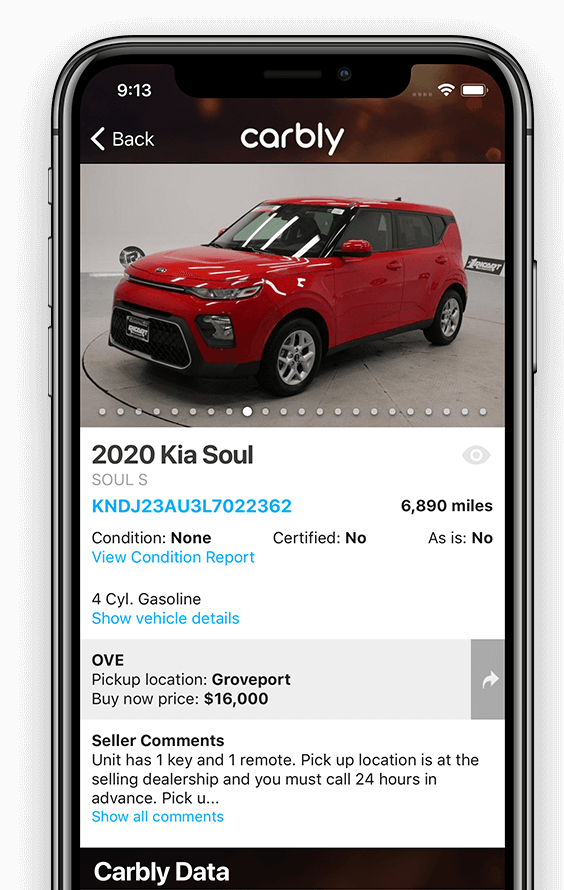
Start Your Free TrialWant to evaluate remote auction opportunities with a clearer view of the retail exit? Carbly Auctions Plus helps dealers review wholesale opportunities alongside vehicle values, history, local retail comparisons, auction announcements, and the expected retail exit. Start your free 14-day trial.